

Tax Collections Remain Strong in 2025 Despite IRS Concerns
Tax Collections Remain Strong in 2025 Despite IRS Concerns
Treasury data through April 28 shows that tax receipts are broadly in line with government projections made earlier this year, before the downsizing of the IRS was announced. Receipts from tariffs have significantly exceeded projections.
Key Points
-
Recent media reports suggested that tax receipts could fall as much as 10 percent by April 15, 2025, creating a shortfall of more than $500 billion by the end of the tax filing season.
-
However, through April 28, individual income and payroll tax receipts are $120 billion higher than last year and statistically in line with projections made by the Congressional Budget Office (CBO) in January 2025.
-
Receipts from customs duties (tariff revenues) have exceeded expectations by almost $15 billion following the Trump Administration’s announcements of new tariffs.
In January 2025, the Congressional Budget Office (CBO) projected that the federal government would collect $5.2 trillion in revenue in fiscal year 2025, an increase of $245 billion compared with 2024.1 However, following announcements of major cutbacks in staffing and services at the Internal Revenue Service (IRS), reports in the media suggested that tax revenues could drop 10 percent by April 15, 2025, due to changing taxpayer behavior and turmoil at the IRS.
PWBM has been monitoring the federal government’s daily spending, receipts, and deficits through our Real-Time Federal Budget Tracker, which is based on daily data from the Treasury Department. Drawing on that data, this brief assesses actual revenue collections in fiscal year 2025, through April 28. This period incorporates the April 2025 income tax filing season (for tax year 2024) and the initial impact of recent tariff increase announcements.
Thus far, the data show no evidence of a significant drop in revenues. Individual income and payroll tax receipts are somewhat lower than expected but up more than $100 billion from last year and in line with CBO’s projections. Meanwhile, customs duties (tariff revenues) are coming in well above January projections.
PWBM’s Real-Time Federal Budget Tracker shows daily and weekly receipts this year compared with 2024 and previous years.2 However, to assess whether these numbers are better or worse than expected, a more sophisticated analysis is needed. As we have done previously, we use CBO’s projections for the fiscal year as a benchmark and compare actual tax receipts with those projections.
Tax receipts follow a mostly predictable pattern over the fiscal year, which PWBM uses to model the timing of collections within the year. Based on the historical pattern of weekly receipts relative to fiscal year total receipts, we estimate expected receipts by week: the level of cumulative weekly tax collections that is consistent with CBO’s projections for the full fiscal year. This is necessary because CBO only publishes its budget projections at an annual (fiscal year) frequency.


Source: Penn Wharton Budget Model using data or projections from the Treasury Department and Congressional Budget Office.
Notes: The shaded areas show prediction intervals at a 90% confidence level.
Expected receipts are amounts consistent with CBO’s January 2025 projections for total receipts in 2025, given the expected timing of tax payments over the fiscal year.
Figure 1 plots PWBM’s estimates of expected receipts (blue) against actual receipts (orange) for fiscal year 2025, which runs from October 1, 2024, to September 30, 2025.3 By the final week of the fiscal year, expected receipts equal CBO’s projections for the full year. Because the exact timing of tax collections varies from year to year, there is uncertainty around expected receipts. This uncertainty is captured in the shaded areas around the blue line, which show prediction intervals at a 90% confidence level. (See the Appendix for more information on how expected receipts and uncertainty are estimated.)
Figure 2 summarizes the central estimates in terms of the gap between expected receipts and actual receipts, which we refer to as the tax receipts gap.4 The colored bars show the cumulative tax receipts gap by major tax category (individual and payroll, corporate, estate and gift, customs, and excise). The solid line shows the cumulative total tax receipts gap including all tax categories.
Source: Penn Wharton Budget Model using data or projections from the Treasury Department and Congressional Budget Office.
Notes: The shaded areas show prediction intervals at a 90% confidence level.
The tax receipts gap in a given week is the difference between cumulative tax receipts since the start of the fiscal year and cumulative receipts expected at that point of the year. Expected receipts are the amounts consistent with CBO’s January 2025 projections for total receipts in 2025, given the expected timing of tax payments over the fiscal year.
Through April 28, the total receipts gap for fiscal year 2025 stands at a shortfall of just $66 billion, or, about 1.3% of $5.2 trillion in expected receipts. Within that total, individual income and payroll taxes are $83 billion lower than expected. This deficit is partly offset by customs duties (tariff revenues), which are $15 billion higher than expected. However, these small shortfalls could simply be due to normal year-to-year variability in the economy and other tax-related factors, a topic which we examine next.
The tax receipts gap depends on the timing of tax payments over the fiscal year, which is largely predictable but varies from year to year.5 That creates uncertainty around expected receipts (shown by the shaded areas in Figure 1) and therefore around the tax receipts gap.
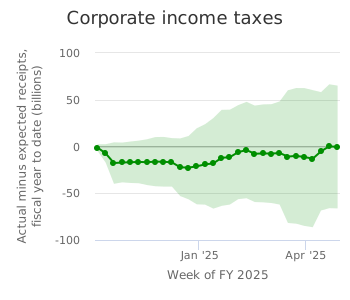
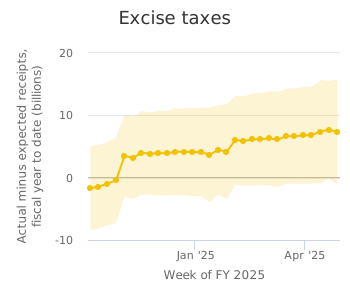
Figure 3 plots the receipts gap in 2025 for each major tax category (solid line) along with prediction intervals that show the degree of uncertainty at a 90% confidence level (shaded areas). If realized tax receipts are statistically consistent with their projected values, then the shaded interval around the gap between the two will include zero. If the shaded area does not include zero, it means that realized tax receipts are outside the normal amount of uncertainty consistent with the projected values. (See the Appendix for more information on how the receipts gap and uncertainty are estimated.) Figure 2 shows that through April 28, the 90% uncertainty interval no longer includes zero for customs duties or estate and gift taxes but does still include 0 for individual income and payroll, corporate, and excise taxes.


Source: Penn Wharton Budget Model using data or projections from the Treasury Department and Congressional Budget Office.
Notes: The shaded areas show prediction intervals at a 90% confidence level.
The tax receipts gap in a given week is the difference between cumulative tax receipts since the start of the fiscal year and cumulative receipts expected at that point of the year. Expected receipts are the amounts consistent with CBO’s January 2025 projections for total receipts in 2025, given the expected timing of tax payments over the fiscal year.
Individual income and payroll taxes: Collections of individual income and payroll taxes are about $83 billion lower than the central expectation for this year, but this shortfall is in line with normal year-to-year variability. As shown in Figure 3, the 90% uncertainty interval includes zero, indicating that total collections for the fiscal year are still on track to meet CBO’s January projections.
Nonwithheld individual income taxes – which include taxes on capital gains and other asset income that are generally paid when taxes are filed – account for much of the uncertainty around revenue projections and were the focus of concerns about a major shortfall this year. Figure 4 plots total receipts of nonwithheld taxes in the month of the tax filing deadline over the last two decades, adjusted for inflation. Nonwithheld tax collections in April 2025 were about $50 billion higher than 2024 and in line with the pre-pandemic trend.6
Source: Penn Wharton Budget Model using data or projections from the Treasury Department and Congressional Budget Office.
Most individual income and payroll tax revenues are collected throughout the year via withholdings from employees’ wages. A smaller share is paid at tax time and reflects tax liability for which withholding is either not possible or not required. The chart above shows that smaller share, adjusted for inflation. The tax filing month is generally in April but was moved to July in 2020 and May in 2021.
Corporate income taxes: Corporate tax receipts have been very close to expectations throughout this year. As of April 28, corporate collections are running at exactly the levels consistent with CBO’s January projections.
Estate and gift taxes: The uncertainty interval in Figure 2 shows that estate and gift tax receipts are meaningfully below expected levels, with a shortfall of around $5 billion so far in fiscal year 2025. However, most of that shortfall occurred prior to the announcement of the IRS staff reductions.
Excise taxes: Receipts from excise taxes have come in a few billion dollars above expectations but are generally in line with CBO’s projections.
Customs duties: Receipts from customs duties (tariffs) are coming in above official projections, exceeding expectations by almost $15 billion as of April 28. This comes as the Administration has recently enacted a series of tariff increases, most notably a 145% levy on goods imported from China. PWBM has analyzed the potential economic and revenue effects of those tariffs in a recent brief and a standalone tariff revenue simulator. The increase in tariff revenues reflects both increased imports in anticipation of the tariff increases and the early impact of higher tariff rates. To track customs revenues in live time, see PWBM’s Real-Time Federal Budget Tracker.
PWBM’s estimates of expected receipts and the receipts gap are based on a conditional forecast of tax payments in each week of the 2025 fiscal year. The forecast assumes that CBO’s revenue projections for the full fiscal year are accurate and predicts when in the year we can expect that revenue to be collected. The receipts gap is then calculated as the difference between realized tax receipts and expected tax receipts at any point in the year.
The forecast of expected receipts comes from a model relating total receipts in a fiscal year to cumulative receipts to date in each week of the year. The model aims to answer the question, “If total revenues this fiscal year are X, how much should have already been collected by week Y of the fiscal year?” It accounts for predictable features of the calendar that change from year to year, such as tax payment deadlines and holidays, but otherwise relies on the timing of tax payments in previous years to predict the timing of payments in the current year. The model is estimated using data from 2013 to 2019, and 2022 to 2024.7
To account for uncertainty around expected receipts, we estimate prediction intervals that show the degree of uncertainty at a 90% confidence level. Prediction intervals account for uncertainty about the model (like the more common confidence interval) as well as uncertainty about predictions from the model (even if the model is accurate on average, any actual observation likely differs from the average). The size of the interval depends on differences across previous years in the timing of tax payments, which occur for a number of reasons. For example, the time it takes the IRS to process returns and payments after the tax filing deadline varies from year to year, adding uncertainty to receipts in late April.
This analysis was produced by Ed Murphy under the guidance of Alex Arnon. Mariko Paulson prepared the brief for the website.
-
The federal fiscal year runs from October 1st to September 30th. ↩
-
The Budget Tracker is on a calendar year basis, while the analysis in this brief is in terms of the fiscal year. ↩
-
Since October 1st, 2024 was a Tuesday, we define a week as the 7-day period from Tuesday through the following Monday. ↩
-
For each week, the tax receipts gap shows whether cumulative tax collections in the year so far are running higher or lower than what is implied by CBO’s projections for the full fiscal year. ↩
-
In 2020 and 2021, the tax filing deadline was moved from April, resulting in major differences in the timing of tax payments. These years are excluded from PWBM’s estimates of the expected timing of tax payments in 2025. ↩
-
For more information on the 2022 surge in nonwithheld taxes, see PWBM’s analysis of the 2022 (tax year 2021) tax filing season. ↩
-
In 2020 and 2021, the tax filing deadline was moved from April, resulting in major differences in the timing of tax payments.
The sample used to estimate the model does not meaningfully affect estimates of the total receipts gap in 2025. Daily tax payments data is available beginning in fiscal year 2006. Including earlier years in the sample slightly increases the estimated individual and payroll receipts gap and decreases the corporate receipts gap by an offsetting amount. ↩