


Our Mission
The Penn Wharton Budget Model (PWBM) is a nonpartisan, research-driven initiative that provides transparent and rigorous economic analysis of fiscal policy, without advocacy. Our work begins with deep theoretical and empirical research, often building on and extending leading academic studies. Using modern software engineering methods, PWBM scales advanced modeling and estimation tools to evaluate how public policies influence the federal budget, the broader economy, and overall human welfare at the national level, often including state and international effects.
Our Approach
PWBM is scaling its work to inform decision-making across the entire U.S. policy landscape by building models that replicate the national population and economy in realistic detail and then using those models to evaluate major federal legislation.
- PWBM's microsimulation model creates a synthetic U.S. population and economy that tracks more than 65 demographic and economic variables per household, calibrated to Census and other large datasets.
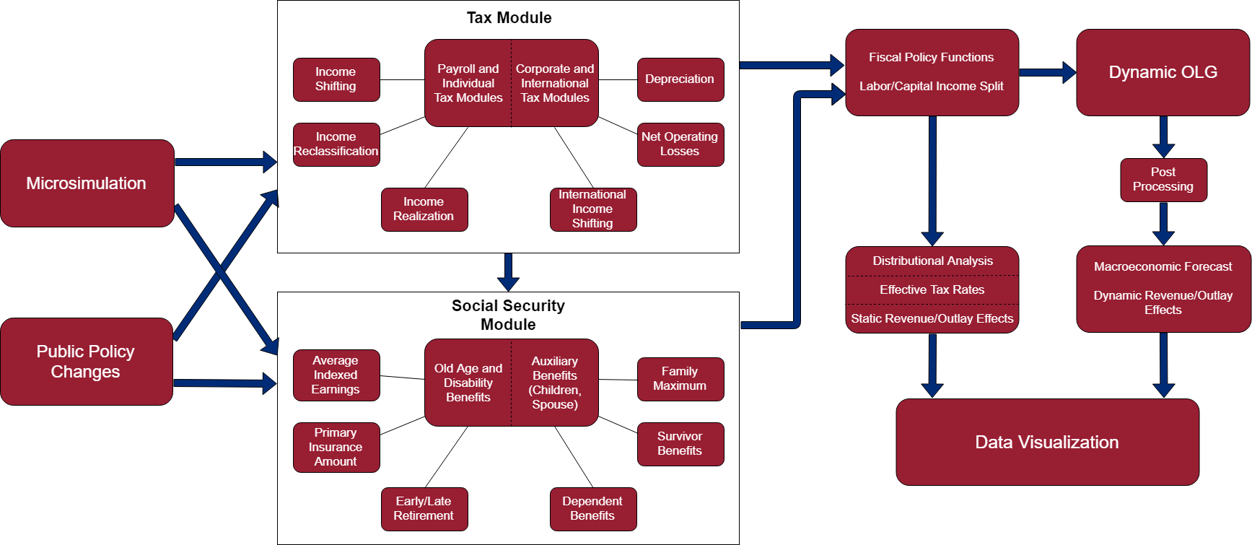
- This microsimulation integrates with tax, Social Security, and other fiscal modules to measure how federal policies change revenues, spending, and distributional outcomes across the country, and feeds into PWBM's dynamic OLG macroeconomic model of the U.S.
- The dynamic OLG models the decisions of household, business, and international investors, projecting the impact on GDP, wages, interest rates, health care prices and other macroeconomic indicators at the national level, under evolving demographic and economic conditions.
- PWBM delivers these national-level insights through public reports and interactive tools that let policymakers and the public test policy ideas "in a sandbox" before legislation is drafted.
Over the remainder of 2026, PWBM will be posting model details in substantial detail.
One example model configuration related to Social Security analysis is as follows:
Work with Policymakers
PWBM works directly with policymakers and their staff to provide insight into the effects of policy changes. Our simulators and briefs are informed by the policy changes being debated on Capitol Hill. We demonstrate the tools available on our website and provide briefings to improve understanding of our results and economic modeling. We also estimate the impact of detailed options for policy changes to help policymakers make data-based decisions when they craft legislation.
When working directly with policymakers we are both discrete and transparent. We do not associate policies or results with policymakers unless a policymaker has an explicit public position on that policy. If a policymaker chooses to indicate that PWBM scored a policy for them, then we post those results to ensure they are not taken out of context, can be verified and are widely available.