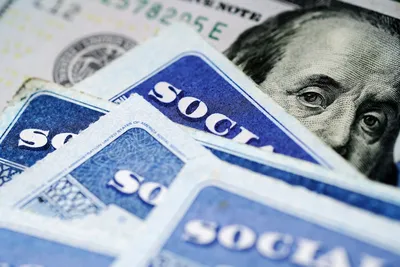
Seven reform packages each avoid Social Security trust fund depletion through 2100. Their 2060 GDP effects range from +0.4 to +12.1 percent and differ in who pays across generations.
PWBM projects that Social Security's combined trust fund depletes in February 2035 with a 75-year shortfall of 4.65 percent of taxable payroll, close to the 2026 Trustees Report despite offsetting differences in fertility and mortality projections.
American retirees receive over twice as much in total federal outlays as working-age adults and six times more than children and young adults. These ratios are even larger on a per-capita basis. Expenditures on retirees are projected to rise even more.
We project that Social Security's Old-Age and Survivors Insurance Trust Fund will deplete in six years (2032). We consider five different reform options that vary in the amount of tax increases and benefit cuts. Traditional policy analysis that dominates federal policymaking often provides very different — even opposite — insights compared to more comprehensive modeling.
The current Social Security program faces a significant shortfall, equal to 4.2 percent of all future covered payroll over the next 75 years. This shortfall persists under alternative and favorable projections of fertility, interest rates, immigration and the projected impact of AI on future wages.
Deporting unauthorized workers over 10 years cuts Social Security revenue, raises deficits by $133 billion (10 yrs) and $884 billion (30 yrs). The Trust Fund depletes 6 months earlier; 75-year deficit rises by 0.25% of payroll.
Eliminating taxes on Social Security benefits reduces incentives to save and work while increasing federal debt. Wages and GDP fall over time. The policy primarily benefits high-income households nearing or in retirement while harming households under thirty and all future generations across the entire income distribution.
Treasury debt held by the public is an explicit pay-as-you-go obligation. The government also runs implicit pay-as-you-go obligations, such as Social Security and Medicare Part A, which are twice as large. Both types of obligations require tax increases and spending cuts to balance the budget over time.
The deduction for pass-through income under section 199A provides a benefit in excess of 20 percent (“excess benefit”) for some taxpayers due to its interaction with the progressive tax rate system. As Congress considers extending 199A beyond 2025, options to remove the excess benefit while maintaining the 20 percent tax benefit could raise between $46B and $178B over the 10-year budget window, depending on design.
A package of 13 major tax and spending reforms, based on standard public economics design principles, is shown to reduce federal debt, increase social insurance, and expand the economy more than any previously analyzed policies by PWBM.
President Biden recently proposed that Medicare and Medicaid cover obesity medications starting in 2026. PWBM estimates a 10-year cost of $140 billion.
After Ireland ended the Double Irish tax planning strategy in 2020, US firms with historical links to Ireland have shifted their intellectual property (IP) away from traditional tax havens to Ireland and the US to take advantage of tax incentives offered by both countries. This has coincided with a significant increase in Irish corporate tax revenue, particularly for less capital-intensive firms. Repatriation of foreign earnings to the United States has also increased, but fiscal benefits to the US have been offset by tax incentives passed under TCJA.
The impact of income-driven repayment (IDR) educational financing plans by income, race, and gender is not generally well understood. Our analysis estimates that approximately 43 percent of the subsidies from President Biden’s Saving on a Valuable Education (SAVE) plan will accrue to current Black student borrowers and 71 percent to current female borrowers. While lower- to middle-income student borrowers stand to gain the most, we estimate that about a fifth of the benefits will go to households in the top 20 percent of the income distribution, and borrowers with graduate-level education who benefit from the SAVE plan tend to experience the highest savings on average.
We analyze a new illustrative policy to create automatic retirement savings accounts for more than 56 million low-income Americans by 2030. The program is fully financed by removing the gross income adjustment for traditional 401k and similar retirement accounts without any additional contribution from households or employers. The program relies on the existing EITC administration without employer participation. After accounting for risk, individual account balances reach over $200,000 by retirement and any balances can be bequeathed upon death.
PWBM estimates that President Biden’s new Medicare proposal would increase the solvency of the Medicare trust fund from the year 2028 to 2053. However, a significant share of that increase comes from redirecting existing (current law) revenue to the trust fund. Another portion comes from unspecific expenditure reductions that lack the details required to score. Counting only new income without unspecified expenditure reductions, we project, as an illustrative alternative, that the HI trust fund would remain solvent until 2037.
PWBM estimates that the Inflation Reduction Act would reduce non-interest cumulative deficits by $248 billion over the budget window with no impact on GDP in 2031. The impact on inflation is statistically indistinguishable from zero. An illustrative scenario is also presented where Affordable Care Act subsidies are made permanent. Under this illustrative alternative, the 10-year deficit reduction estimate falls to $89 billion.
PWBM estimates that Medicaid’s inflation adjusted expenditures on Long Term Care services will increase from $130 billion in 2020 (0.62 percent of GDP) to $179 billion in 2030 (0.71 percent of GDP). We project that Medicaid expenditures on Nursing Home and Home Health will increase 4.7 percent and 6.9 percent per year above inflation through 2030, respectively.
PWBM estimates that auto-enrolling into a Medicare Advantage (MA) plan those who age into Medicare and fail to sign up for Medicare Fee-For-Service (FFS) or another MA plan would increase enrollment in the MA program by 1.4 million people in 2032 and increase federal outlays by $189 billion over the 2022-32 period. If we assume that in response to such a policy change people would lose the incentive to enroll in Medicare FFS and instead get automatically enrolled into a MA plan, enrollment would increase by 6.8 million people in 2032 and outlays would increase by $269 billion over the 2022-32 period.
PWBM projects that the long-run aggregate macroeconomic effects of Senator Joe Manchin's $1.5T reconciliation framework would be negligible. The economic benefits would largely accrue to younger, poorer households while the economic costs would fall mostly on richer households.
PWBM projects that the legalization provisions of the U.S. Citizenship Act proposed by President Biden would increase per capita spending on the Supplemental Nutrition Assistance Program (SNAP) by 1.2 percent in 2031 and 0.7 percent 2050 relative to the current policy baseline. Per capita payroll taxes would increase by 1.3 and 0.2 percent relative to the current policy baseline, in 2031 and 2050 respectively.
As part of PWBM’s “Democratizing the Budget Contest,” Andrew Biggs, Ph.D. proposed a package of Social Security reforms centered around gradually transitioning the program to a flat benefit for new retirees. PWBM projects that this proposal would reduce the program’s conventional 75-year imbalance by 2.44 percent of taxable payroll, leaving a remaining imbalance of 0.8 percent of current law taxable payroll. The proposal would decrease GDP by 0.6 percent in 2030 while increasing GDP by 0.6 percent in 2050.
We estimate the budgetary, economic and distributional effects of raising the Social Security taxable maximum to $300,000 starting on January 1st, 2021. We project that it would raise $1.2 trillion of additional revenue on a conventional basis over the 10-year budget window and lower GDP 1.7 percent by 2050. Families in the top 10 percent of the income distribution would bear 93 percent of the overall burden of this tax increase.
Using PWBM’s new dynamic distributional analysis, we find that the Social Security 2100 Act benefits wealthy, retired households at the expense of young, high-income households.