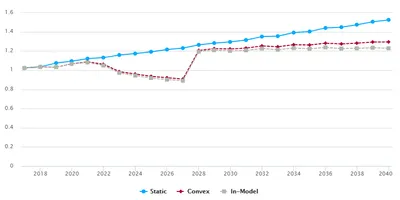
Seven reform packages each avoid Social Security trust fund depletion through 2100. Their 2060 GDP effects range from +0.4 to +12.1 percent and differ in who pays across generations.
We estimate that the United States federal debt cannot rationally exceed roughly 210 percent of GDP as an outer limit. Under historical excess cost growth in healthcare, this outer limit is likely reached within 20 years; there is a 25% chance of reaching it in 14 years. Debt markets unravel earlier if beliefs about government repayment shift.
PWBM projects the U.S. resident population will grow from 343.5 million in 2026 to 371.5 million in 2056, with net immigration accounting for more than 100 percent of this growth. Real GDP growth slows from 2.2 percent to 1.1 percent as growing mandatory spending is matched with shrinking working-age labor force participation.
We project that the new DHS H-1B selection rule, going into effect in March 2026, will shift the H-1B visa allocation toward higher-paid and higher-education foreign-born workers, but by less than alternative designs being debated. Based on data from the current random lottery in the last five years, we estimate that the new DHS rule will have no significant impact on wages of U.S.-born workers, including non-college, college-educated, and STEM workers. Any reduction in competition from fewer STEM H-1Bs is offset by a reduction in productivity growth.
Over 700,000 Temporary Protected Status (TPS) recipients lose legal status by the end of 2025, including 550,000 who are legally working. We estimate that TPS recipients contribute over $36 billion in annual GDP. Withdrawing their work authorization could add to labor shortages in construction, cleaning, and hospitality, especially in Florida, Texas and New York.
We estimate that AI will increase productivity and GDP by 1.5% by 2035, nearly 3% by 2055, and 3.7% by 2075. AI’s boost to annual productivity growth is strongest in the early 2030s but eventually fades, with a permanent effect of less than 0.04 percentage points due to sectoral shifts.
It is well known that mass deportation reduces aggregate economic variables like GDP due to scale effects. We project that deportation also reduces wages of high-skill workers, compromising 63% of workers. Still, authorized low-skilled workers can see their wages increase but only if the deportation policy is permanently sustained after 4 years. Even with new funds provided in the 2025 OBBBA, we estimate that permanent deportation would cost an additional $900 billion over the first 10 years.
We estimate the reconciliation bill signed by President Trump increases primary deficits by $3.2 trillion over 10 years. The dynamic cost, including changes to the economy, is larger at $3.6 trillion. GDP falls by 0.3 percent in 10 years and 4.6 percent in 30 years.
If spending and tax changes in Reconciliation are made permanent, federal debt increases by 11.1 percent in 10 years and 24.3 percent in 30 years. GDP remains flat and wages fall by 0.5 percent. Dynamic costs exceed conventional costs in the budget window.
We estimate the House reconciliation bill increases primary deficits by $3.3 trillion over 10 years. Even so, GDP rises in the short and long term, as precautionary increases in labor supply and savings respond to a reduced social safety net.
Many trade models fail to capture the full harm of tariffs. PWBM projects Trump’s tariffs (April 8, 2025) will reduce long-run GDP by about 6% and wages by 5%. A middle-income household faces a $22K lifetime loss. These losses are twice as large as a revenue-equivalent corporate tax increase from 21% to 36%, an otherwise highly distorting tax.
Eliminating taxes on Social Security benefits reduces incentives to save and work while increasing federal debt. Wages and GDP fall over time. The policy primarily benefits high-income households nearing or in retirement while harming households under thirty and all future generations across the entire income distribution.
We examine two major investment tax incentives for the computer sector. The impact on computer-sector investment as well as economy-wide investment is very small, even when the computer sector is modeled as a production complement.
PWBM estimates that President Biden’s FY2025 budget proposal would reduce primary deficits by $1.7 trillion over the 2025-2034 budget window. Accounting for economic feedback effects, GDP falls by 0.8 percent relative to current law in 2034. By 2054, debt falls by 5.4 percent and GDP declines by 1.3 percent relative to current law.
Note: This document was updated on 5/21/2024 to include a conventional distributional analysis and a dynamic distributional analysis of the three policy bundles.
We examine recent trends in the activities of US multinationals and their foreign affiliates using data from the Bureau of Economic Analysis’s annual survey of US direct investment abroad. Since the passage of the Tax Cuts and Jobs Act (TCJA), multinational activity has become more domestically concentrated, continuing a trend that started before the legislation. This has coincided with a decline in the US effective corporate tax rate and relatively stable foreign effective tax rates.
U.S. population growth is projected to decline, and the population will become much older over time. Preventing these outcomes will require faster immigration by several multiples of its current rate.
The economic costs of the COVID-19 pandemic were widely expected to fall disproportionally on women. Instead, the employment rate of prime age women recovered faster than men’s and rose to its highest point in U.S. history in 2023. We show that the resilience of women’s employment is driven by two long-term trends that predate the pandemic and continued through it: 1) the growing share of women who are college graduates, and 2) the rising labor force participation of college-educated mothers with young children.
PWBM estimates that Title I of the Build It in America Act would add $76 billion to the budget deficit over the next decade and reduce deficits by $18 billion during the subsequent second decade. It would temporarily boost business investment and GDP during the next two years while lowering GDP in subsequent years. If lawmakers made the extensions permanent, the budgetary cost would rise to $1.25 trillion over the next two decades and GDP would largely remain unchanged, as the tax incentive effects and debt effects mostly offset.
Several revenue and spending provisions in The Tax Cuts and Jobs Act (TCJA) are scheduled to expire (“sunset”) by the end of 2025. We estimate that “extenders” (“no sunset”) would increase the federal debt held by the public from 226.0 percent of GDP to 261.1 percent of GDP by 2050.
Under current law, we project that national debt will rise to 225% of GDP by 2050 and continue to rise thereafter. Changing demographics will reduce future economic growth.
PWBM estimates that the Senate-passed version of the Inflation Reduction Act would reduce non-interest cumulative deficits by $264 billion over the budget window. The impact on inflation is statistically indistinguishable from zero. GDP falls slightly within the first decade while increasing slightly by 2050. Most, but not all, of the tax increases fall on higher income households.
PWBM estimates that the Inflation Reduction Act would reduce non-interest cumulative deficits by $248 billion over the budget window with no impact on GDP in 2031. The impact on inflation is statistically indistinguishable from zero. An illustrative scenario is also presented where Affordable Care Act subsidies are made permanent. Under this illustrative alternative, the 10-year deficit reduction estimate falls to $89 billion.
We estimate that the U.S. federal government faces a permanent fiscal imbalance equal to over 10 percent of all future GDP under current law where future federal spending outpaces tax and related receipts. Federal government debt will climb to 236 percent of GDP by 2050 and to over 800 percent of GDP by year 2095 (within 75 years).
We estimate that each new preschooler for a universal pre-K program requires about $21,000 in new construction costs for facilities expansion. Including non-construction costs, a universal pre-K program for three- and four-year-olds will cost about $351 billion over the 10-year budget window. If made permanent after 10 years, this program will have essentially no impact on long-run GDP. A pre-K program for just four-year-olds reduces the 10-year cost to $196 billion and slightly increases long-run GDP, if that program is made permanent.
PWBM estimates that Medicaid’s inflation adjusted expenditures on Long Term Care services will increase from $130 billion in 2020 (0.62 percent of GDP) to $179 billion in 2030 (0.71 percent of GDP). We project that Medicaid expenditures on Nursing Home and Home Health will increase 4.7 percent and 6.9 percent per year above inflation through 2030, respectively.
PWBM estimates that H.R. 5376, the Build Back Better Act, would increase spending by $2.1 trillion over the 10-year budget window while increasing revenue by $1.8 trillion, for a 10-year deficit of $274 billion. By 2050, the proposal would decrease GDP by 0.2 percent, relative to current law.
PWBM estimates that the White House’s Build Back Better reconciliation framework would increase spending by $1.87 trillion over the 10-year budget window and revenues by $1.56 trillion over the same period. By 2050, the proposal would increase federal debt by 2.0 percent and decrease GDP by 0.1 percent, relative to the current law baseline.
Using recently available data on learning loss from pandemic school closures, PWBM estimates that projected 2051 GDP is 1.4 percent lower than it would have been without the learning loss. Extending the 2021-22 school year for all public schools by one month would cost $78 billion and limit the reduction in 2051 GDP to 1.0 percent—a net present value gain in GDP of more than $1 trillion over the next three decades, equal to a $15.14 return for each $1 invested.
Higher inflation reduces the real value of the government’s outstanding debt while increasing the tax burden on capital investment due to lack of inflation indexing. Increasing the current annual inflation target regime from 2 percent to 3 percent inflation reduces debt while lowering GDP.
The USDA re-evaluation of the Thrifty Food Plan increases the average SNAP benefit by $36.24 per person per month starting in October 2021. PWBM projects that the increase in SNAP spending lowers GDP by 0.2 percent by 2031. People who receive SNAP as well as older working age individuals are helped by policy change while young people with high incomes as well as rich retirees are harmed due to lower future wages and a fall in the return to capital.
By 2051, we find that a combination of targeted preschool and targeted childcare programs increase GDP by 0.1 percent relative to current policy, even if deficit financed. Universal versions of these programs are more costly and would instead reduce GDP by 0.2 percent by 2051.
The bipartisan Senate infrastructure deal, endorsed by President Biden, authorizes about $548 billion in additional infrastructure investments, which we estimate is funded by $132 billion in new tax provisions and $351 billion in new deficits. We project that proposal would have no significant effect on GDP by end of the budget window (2031) or in the long run (2050).
PWBM estimates that President Biden’s FY2022 budget proposal would increase spending by $5.9 trillion and increase revenue by $3.9 trillion over the 2022-2031 budget window. By 2050, we project that the President’s budget proposals would decrease public debt by 7.3 percent and decrease GDP by 1.1 percent relative to current law.
Government spending redirects real resources in the economy and can crowd out private capital formation. An additional $1 trillion debt this year could decrease GDP by as much as 0.28 percent in 2050.
Public infrastructure investment boosts the productivity of private capital and labor, leading to higher output, but this positive effect can be offset if the investment is financed with additional government borrowing. PWBM estimates that an illustrative 10-year, $2 trillion public investment plan will raise public capital by 4.6 percent but lower private capital by 0.8 percent in 2040, with a net zero effect on GDP in 2040.
We estimate that Sen. Capito’s $330 billion infrastructure package, funded by user fees over 8 years, would increase GDP by about 0.05 percent in 2050. A $579 billion infrastructure investment being considered by a bipartisan group of senators, would increase output in 2050 by 0.1 percent if funded by user fees or have roughly zero net effect on GDP if deficit financed.
PWBM estimates that the learning loss from school closures reduced GDP by 3.6 percent in 2050. Extending the 2021-22 school year by one month would cost about $75 billion nationally but would limit the reduction in GDP to 3.1 percent. This smaller reduction in GDP produces a net present value gain of $1.2 trillion over the next three decades, equal to about a $16 return for each $1 invested in extending the 2021-22 school year.
PWBM projects that the American Families Plan (AFP) would spend $2.3 trillion, about $500 billion more than the White House’s estimate, over the 10-year budget window, 2022-2031. We estimate that AFP would raise 1.3 trillion in new tax revenue over the same period. By 2050, the AFP would increase government debt by about 4 percent and decrease GDP by 0.3 percent.
PWBM projects that the American Jobs Plan proposed by President Biden would spend $2.7 trillion and raise $2.1 trillion dollars over the 10-year budget window 2022-2031. The proposal’s business tax provisions continue past the budget window, decreasing government debt by 6.4 percent and decreasing GDP by 0.8 percent in 2050, relative to current law.
PWBM projects that by 2050, the legalization provisions of the U.S. Citizenship Act proposed by President Biden would increase the size of the U.S. population by 4.21 percent, increase GDP by 0.5 percent, but decrease GDP per capita by 0.2 percent. More specific legalization proposals targeted at farm workers, DACA recipients, and essential workers would each increase GDP per capita by 0.1 percent in 2050.
PWBM projects that vaccinating all those eligible by reducing vaccine hesitancy would prevent up to 8.3 million cases in 2021, increase employment by 2.6 million in December 2021, and boost Q4 2020 to Q4 2021 GDP growth by 2 percentage points. In fact, failure to reduce vaccine hesitancy could lead to a “perfect storm” if people also become optimistic and increase their social contact rates beyond the baseline rates that we previously projected. Indeed, increasing social contact rates to 85 percent of pre-COVID levels by the end of 2021 would lead to up to 4.6 million additional COVID-19 cases in 2021.
PWBM projects that the Ultra-Millionaire Tax Act of 2021, introduced by Senator Elizabeth Warren, would raise $2.1 trillion over the standard 10-year budget window (2022-2031) under scoring conventions used by government agencies. Incorporating the effects of enhanced IRS enforcement, our projection rises to $2.4 trillion over 2022-2031 and $2.7 trillion over 2023-2032. Also incorporating macroeconomic effects of the Act reduces estimated revenue to $2.0 trillion over 2022-2031 and $2.3 trillion over 2023-2032. We estimate that the Act would reduce GDP by 1.2 percent in 2050.
This brief analyzes the epidemiological and economic effects of maintaining, increasing, or decreasing the current pace of daily COVID-19 vaccinations. PWBM projects that doubling the number of vaccine doses administered daily would boost employment by more than 2 million and real GDP by about 1 percent over the summer of 2021, with smaller effects later in the year.
PWBM estimates that the $1.9 trillion in spending in the full Biden relief plan would increase GDP in 2021 by 0.6 percent. Over time, the additional public debt resulting from the Biden plan would decrease GDP by 0.2 percent in 2022 and 0.3 percent in 2040.
As part of PWBM’s “Democratizing the Budget Contest,” Andrew Biggs, Ph.D. proposed a package of Social Security reforms centered around gradually transitioning the program to a flat benefit for new retirees. PWBM projects that this proposal would reduce the program’s conventional 75-year imbalance by 2.44 percent of taxable payroll, leaving a remaining imbalance of 0.8 percent of current law taxable payroll. The proposal would decrease GDP by 0.6 percent in 2030 while increasing GDP by 0.6 percent in 2050.
The TEACHUP program, proposed by Rick Miller, Ph.D. as part of the PWBM Democratizing the Budget Contest, would give grants to states in order to provide full-day preschool for four-year-old children at or below 200 percent of the poverty line. On a conventional basis, PWBM projects that TEACHUP would cost $92.4 billion over ten years and a total of $282.53 billion by 2050. However, on a dynamic basis that includes productivity effects and expansion of the tax base, PWBM estimates that the program would effectively pay for itself by 2050 by holding public debt nearly constant.
We estimate that each month of school closures in response to the COVID pandemic cost current students between $12,000 and $15,000 in future earnings due to lower educational quality. We also estimate total value-of-life, medical, and productivity costs per infection at $38,315 for September 2020. Using these costs, we calculate the cost-benefit threshold to keeping schools closed for October at over 0.355 new expected infections in the community per student kept out of school.
The Biden healthcare plan focuses on expanding access and affordability of insurance and decreasing prescription drug prices. We estimate that by 2030, relative to current law, the Biden plan would decrease the uninsurance rate from 10 percent to 6 percent, decrease private insurance premiums by 23 percent and out-of-pocket spending by 16 percent, and decrease the percent of the population that forgoes medical care from 7 percent to 4 percent. The Biden healthcare plan would increase net spending by $352 billion over ten years but would reduce debt by 4.5 percent over that period due to dynamic growth effects.
PWBM uses dynamic distributional analysis to evaluate the effects of the Biden platform on different age and income groups. We find that working-age individuals in the bottom 40 percent of taxable income benefit the most due to expanded health insurance, increases in housing subsidies, and lower cost of prescriptions in the Biden platform, while young, high-income individuals and wealthy retirees see net losses due to tax increases and lower returns on their savings.
Using PWBM’s dynamic model, we show the macroeconomic effects of Presidential candidate Biden’s immigration proposal. By 2050, GDP increases by 1.7 percent in 2050 relative to current law while GDP per capita stays the same.
We use PWBM’s new dynamic model enhancement of the business sector to analyze several foreign and domestic business taxation provisions from the Biden tax plan. While raising the effective tax rate on foreign profits increases domestic capital, wages, and GDP, provisions that raise domestic business taxes have the opposite effect—when combined, these business tax provisions decrease the capital stock by 0.21 percent and decrease wages by 0.69 percent in 2050.
We estimate that the anticipated Trump administration bill to invest $1 trillion in infrastructure would increase GDP up to $720 billion through June 2022.
We estimate that a large infrastructure bill would increase GDP by no more than $360 billion per year for 2020 and 2021. Short-run GDP expansion from new infrastructure spending is limited by available projects and likely social distancing measures, and so states could not absorb more than $300 billion per year in new federal aid over the next two years.
In an attempt to prevent and reverse layoffs due to coronavirus, the recently-passed CARES Act established a new lending program targeted at businesses with 500 or fewer employees. These businesses account for 99.7 percent of all firms, 47.3 percent of employment, 40.7 percent of annual payroll, and about one-third of the growth in employment and wages. These businesses also account for 60 percent of employment in the leisure and hospitality sector, which has been disproportionately harmed by the pandemic’s effects.
We estimate the lasting macroeconomic effects of the anticipated recession due to coronavirus, as the initial shock leads to lower federal revenue and higher debt. If the economy recovers the year after a deep recession ("V shape"), we project that federal debt will be 3.2 percent higher and GDP will be 0.3 percent lower by 2030. If the recovery occurs over two additional years (“U shape”), federal debt rises by 5.9 percent and GDP falls by 0.6 percent lower by 2030. Barring future fiscal policy to reduce debt, so-called “potential GDP” will, therefore, be permanently lower due to the coronavirus.
If oil prices remain at current levels through the end of 2020, we estimate that growth in business investment will be 1.9 percentage points lower and growth in GDP will be 0.25 percentage points lower in 2020.
We estimate the budgetary, economic and distributional effects of raising the Social Security taxable maximum to $300,000 starting on January 1st, 2021. We project that it would raise $1.2 trillion of additional revenue on a conventional basis over the 10-year budget window and lower GDP 1.7 percent by 2050. Families in the top 10 percent of the income distribution would bear 93 percent of the overall burden of this tax increase.
We estimate the budgetary, economic and distributional effects of eliminating all Schedule-A itemized deductions starting on January 1st, 2021. We project that it would raise about $2.1 trillion of additional revenue on a conventional basis over the 10-year budget window and increase GDP by 2.3 percent by 2050. Families in the top 10 percent of the income distribution would bear 75 percent of the overall burden of this tax increase.
We estimate the budgetary and economic effects of increasing the top rate on long-term capital gains and qualified dividends from 20 percent to 24.2 percent, which is enacted on January 1st, 2021. We project that it will raise around $60 billion of additional revenue on a conventional basis over the 10-year budget window and increase GDP by 0.1 percent by 2050.
We estimate the budgetary and economic effects of a new broad-based 1 percent value-added tax (VAT) with a progressive universal rebate calculated based on earnings, which is enacted on January 1st, 2021. We project that it will raise $700 billion of additional revenue on a conventional basis over the 10-year budget window and increase GDP by 0.8 percent by 2050.
We estimate the budgetary and economic effects of a new carbon tax of $30 per ton of emissions, which is enacted on January 1st, 2021, rising by inflation plus 5 percent through 2050. We project that it raises $1.6 trillion of additional revenue on a conventional basis over the 10-year budget window and increases GDP by 2.2 percent by 2050.
PWBM’s Jon Huntley and Richard Prisinzano discussed how the financing of a federal infrastructure plan influences its effect on economic growth. Even though infrastructure investments increase productivity, plans that are deficit-financed can reduce GDP relative to current policy.
We estimate that a one-year “payroll tax holiday” would cost the federal government between $141 and $151 billion over the standard budget window and increase GDP by 0.3 percent in 2020, with effects eventually turning slightly negative over time with higher deficits.
PWBM introduces a new measure of distribution that corrects numerous deficiencies in existing distributional measures that are commonly used to evaluate policy analysis.
Using PWBM’s new dynamic distributional analysis, we find that the Social Security 2100 Act benefits wealthy, retired households at the expense of young, high-income households.
PWBM’s Efraim Berkovich, the Wharton School’s Marshall Meyer and Mary Lovely of the Maxwell School of Syracuse University discussed how the recently imposed tariffs on Chinese goods are raising prices for consumers, disrupting supply chains and weighing down economic growth in the long-run.
We project that even if the recently imposed tariffs are removed, GDP will be permanently smaller relative to having had no trade war. Extending the current trade war by several more years will lead to smaller losses in GDP in 2020 but will reduce GDP by more in the long run.
On June 7, Hill staffers, fiscal experts, and PWBM gathered to discuss the federal revenue loss created by tax avoidance. The U.S. has different tax rates for different income streams, thus there are opportunities for individuals and businesses to reduce their tax bills by recharacterizing income to pay a lower rate.
In today’s low interest rate environment, the cost of federal debt is lower than it used to be. However, long-run concerns loom. PWBM projections show that policies that reduce federal debt over time produce more economic growth than current policy.
Introducing PWBM’s Interactive 2020 Campaign Issue State Maps. We use data to inform people about the impact of campaign proposals on their states. Here we present six indicators focused on immigration policy for each state. Although PWBM has shown that increasing immigration boosts economic growth for the U.S. as a whole, these indicators imply that the impact of changes to immigration policy on a state will depend on the demographics of that state.
PWBM projects the number of unauthorized immigrants to fall from a peak of 4 percent of the U.S. population in 2007 to under 2.5 percent in 2050. In recent years, fewer unauthorized immigrants have arrived from Mexico while more have arrived from Central America. PWBM projects that future growth of the population of unauthorized immigrants will be driven by visa overstays.