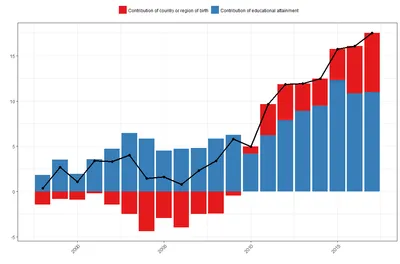
PWBM projects that exempting STEM immigrants from green card caps would raise U.S. output 4.0 percent and lower federal debt 5.5 percent by 2059, with low-education workers gaining most and incumbent foreign-born STEM workers persistently worse off.
We project that the new $100,000 H-1B fee and wage-weighted lottery would raise mean selected pay by $7,551 to $18,799 (6.7 to 16.7 percent) over the prior random lottery at current prevailing wages, with most of the gain from the weighting, not the fee.
PWBM projects the U.S. resident population will grow from 343.5 million in 2026 to 371.5 million in 2056, with net immigration accounting for more than 100 percent of this growth. Real GDP growth slows from 2.2 percent to 1.1 percent as growing mandatory spending is matched with shrinking working-age labor force participation.
DOL's proposed experience benchmarking alternative would raise mean H-1B compensation by $27,686 (+24.7%) over the random lottery — $7,076 above the NPRM primary rule — while excluding 56 percent of current registrations and shifting selections toward younger workers.
DOL's proposed prevailing wage increase would nearly double the compensation effect of the new wage-weighted H-1B lottery, raising mean selected-registrant pay by $20,611 (+18.4%) over the prior random lottery.
We analyze how employers could exploit DHS' new H-1B lottery rules by reclassifying positions into closely related occupations with lower prevailing wages to increase their chance of selection. We find that 61 percent of registrations would achieve a higher wage level through reclassification, undoing 42 percent of the expected compensation increase.
We project that the new DHS H-1B selection rule, going into effect in March 2026, will shift the H-1B visa allocation toward higher-paid and higher-education foreign-born workers, but by less than alternative designs being debated. Based on data from the current random lottery in the last five years, we estimate that the new DHS rule will have no significant impact on wages of U.S.-born workers, including non-college, college-educated, and STEM workers. Any reduction in competition from fewer STEM H-1Bs is offset by a reduction in productivity growth.
Over 700,000 Temporary Protected Status (TPS) recipients lose legal status by the end of 2025, including 550,000 who are legally working. We estimate that TPS recipients contribute over $36 billion in annual GDP. Withdrawing their work authorization could add to labor shortages in construction, cleaning, and hospitality, especially in Florida, Texas and New York.
The current Social Security program faces a significant shortfall, equal to 4.2 percent of all future covered payroll over the next 75 years. This shortfall persists under alternative and favorable projections of fertility, interest rates, immigration and the projected impact of AI on future wages.
It is well known that mass deportation reduces aggregate economic variables like GDP due to scale effects. We project that deportation also reduces wages of high-skill workers, compromising 63% of workers. Still, authorized low-skilled workers can see their wages increase but only if the deportation policy is permanently sustained after 4 years. Even with new funds provided in the 2025 OBBBA, we estimate that permanent deportation would cost an additional $900 billion over the first 10 years.
We evaluate two immigration policies that shift 10 percent of future low-skilled immigration toward either: (i) high-skilled immigrants (“ HSI ”) that otherwise maintains the current share of STEM workers within the high-skilled group, or (ii) only high-skilled STEM workers (“ HSI STEM ”) that increases the share of STEM relative to other high-skill workers. The number of total immigrants remains the same under both policies. Both policies grow the economy, reduce federal debt, and increase wages across all income groups: lower-skilled, higher-skilled non-STEM workers, and higher-skilled STEM workers. In fact, this policy change affords the rare opportunity of a “Pareto improvement” benefitting all groups.
The COVID-19 spike in mortality is the pandemic’s most direct demographic consequence, but not the only one. Factoring in changes in fertility, disruptions to immigration, and indirect demographic spillovers, we estimate that the pandemic reduced the U.S. population 0.5 percent over the long term.
The COVID-19 pandemic caused major disruptions to U.S. immigration. Policymakers imposed travel restrictions, stopped visa processing, and made significant changes at the border. The pandemic and policy response led to more employment-based immigration and increased illegal border crossings instead of reducing them.
U.S. population growth is projected to decline, and the population will become much older over time. Preventing these outcomes will require faster immigration by several multiples of its current rate.
PWBM estimates that exempting from immigrants with advanced STEM degrees from numerical limitations on green cards would reduce deficits by $129 billion over the 2025-2034 period and by $634 billion over the 2035-2044 period.
We report estimates from the Penn Wharton Budget Model (PWBM) that exempting employment-based green cards from statutory limits for applicants (and their families) who have earned a doctoral or master’s degree in a STEM field---similar to Section 80303 in H.R. 4521---would reduce federal budget deficits by $129 billion from 2025 to 2034. In contrast, a conventional budget estimate, which would include projected increases in federal spending but not the effect of a larger population on federal tax revenues, shows an increase in federal deficits of $4 billion.
The U.S. population’s total fertility rate is now approximately 1.7 births per female, which is below the replacement rate of 2.1 that is required for the U.S. population not to shrink without increases in immigration. Women are delaying motherhood, from the 2006 average age range of 25 to 29 to the 30 to 34 age range today.
In a general equilibrium, overlapping generations model with heterogeneous agents and stochastic labor productivity, we account for differences between immigrants and natives to investigate the macroeconomic effects of immigration to the United States. Including household labor productivity transitions jointly with legal status transitions, we model policies which change the size and composition of the immigrant population and analyze implications for government spending and tax revenues. Temporary increases in legal immigration rates lead to long term fiscal benefits, in aggregate and on a per capita basis, in part because of decreases in the old-age dependency ratio. These policies produce long lasting, multi-generational effects, as the children of new immigrants enter the workforce. A six year increase in legal immigration by 25% is predicted to lead to a 0.08% increase in per capita GDP and a 0.41% decrease in total government debt in 2032, but, by 2052, the policy increases per capita GDP by 0.30% while government debt is 1.34% lower than in the baseline. Policies which legalize unauthorized immigrants imply a trade-off between higher wages for newly-legalized workers and increased government debt through additional spending on social programs for those same immigrants. A full legalization policy leads to a 0.02% increase in government debt by 2032 and a 1.26% increase by 2052. Per capita GDP, meanwhile, is 0.01% lower than baseline in 2032 and 0.37% lower in 2052.
PWBM projects that the legalization provisions of the U.S. Citizenship Act proposed by President Biden would increase per capita spending on the Supplemental Nutrition Assistance Program (SNAP) by 1.2 percent in 2031 and 0.7 percent 2050 relative to the current policy baseline. Per capita payroll taxes would increase by 1.3 and 0.2 percent relative to the current policy baseline, in 2031 and 2050 respectively.
PWBM projects that by 2050, the legalization provisions of the U.S. Citizenship Act proposed by President Biden would increase the size of the U.S. population by 4.21 percent, increase GDP by 0.5 percent, but decrease GDP per capita by 0.2 percent. More specific legalization proposals targeted at farm workers, DACA recipients, and essential workers would each increase GDP per capita by 0.1 percent in 2050.
Using PWBM’s dynamic model, we show the macroeconomic effects of Presidential candidate Biden’s immigration proposal. By 2050, GDP increases by 1.7 percent in 2050 relative to current law while GDP per capita stays the same.
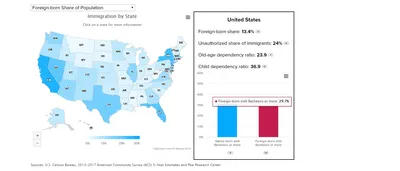
Introducing PWBM’s Interactive 2020 Campaign Issue State Maps. We use data to inform people about the impact of campaign proposals on their states. Here we present six indicators focused on immigration policy for each state. Although PWBM has shown that increasing immigration boosts economic growth for the U.S. as a whole, these indicators imply that the impact of changes to immigration policy on a state will depend on the demographics of that state.
We project that increasing annual net legal immigration leads to a younger and more educated U.S. population. These population changes are likely to have a positive impact on entitlement finances and tax burdens relative to current policy. In contrast, decreasing annual net legal immigration likely has the opposite effects.
PWBM projects that by 2050 one in ten U.S. citizens will be foreign-born, up from 7 percent today. We account for different historical naturalization patterns of immigrants from different countries, including the time immigrants reside in the U.S. Thus, this increase reflects shifts in the origins of lawful immigrants. In particular, we project that the shift away from immigrants arriving from Mexico and toward immigrants arriving from Asia to continue.
PWBM projects the number of unauthorized immigrants to fall from a peak of 4 percent of the U.S. population in 2007 to under 2.5 percent in 2050. In recent years, fewer unauthorized immigrants have arrived from Mexico while more have arrived from Central America. PWBM projects that future growth of the population of unauthorized immigrants will be driven by visa overstays.