


U.S. Demographic Projections: With and Without Immigration
U.S. Demographic Projections: With and Without Immigration
U.S. population growth is projected to decline, and the population will become much older over time. Preventing these outcomes will require faster immigration by several multiples of its current rate.
Key Points
-
Recent declines in the total fertility rate have pushed it below the population replacement level of 2.1 percent per woman. The Penn Wharton Budget Model (PWBM) microsimulation projects the TFR to remain below this level during the next few decades.
-
Mortality projections suggest improvements in longevity by all groups. College educated individuals enjoy the lowest mortality rates, an advantage that will persist over time.
-
Persistently low fertility will make the balance of births minus deaths negative. A positive, albeit declining, population growth rate will be sustained, however, because of sustained positive net immigration.
-
The shift of baby-boomer workers into retirement portends a decline in the worker-to-retiree ratio from 3.0 today to 2.0 by 2075. A faster annual immigration rate, equal to about 3.5 times the current rate, would be required to restore the ratio over the long term.
Key determinants of the future size and composition of the population are fertility, mortality, and net immigration rates by person attributes including race, gender, and education among others.
The Penn Wharton Budget Model’s microsimulation is based on calibrating and projecting more than 60 U.S. demographic variables such as age, gender, race, marital status, education, family size. region of residence, immigration, legal status, etc. using micro-data on the United States population. The data are taken from various sources including the Census Bureau, The Centers for Disease Control, the Bureau of Labor Statistics, the University of Michigan Survey Center, and others. All statistics and Figures cited in this Brief are based on the PWBM microsimulation’s projections.
This Brief describes the microsimulation’s outcomes of fertility, mortality, and immigration, population growth, worker-retiree ratio, and population composition by race and education over the next few decades. The outcomes are classified by gender, age, education, and race. Under these projections, U.S. population’s growth will slow but remain positive. The population’s composition by race and education will change significantly over the coming decades.
United States’ total fertility rate (TFR) has declined during the 2nd decade of this century. According to the Congressional Budget Office, U.S. TFR (the average number of children per woman over her fertile life span of 14-49, assuming current fertility rates by female age) remained close to 2.0 for two decades since the mid-1980s.1 A sustained decline after the Great Recession of 2008-09 through Covid-19 onset in 2020 saw the TFR reaching below 1.7 in some years. Figure 1 shows PWBM’ projections of TFR.

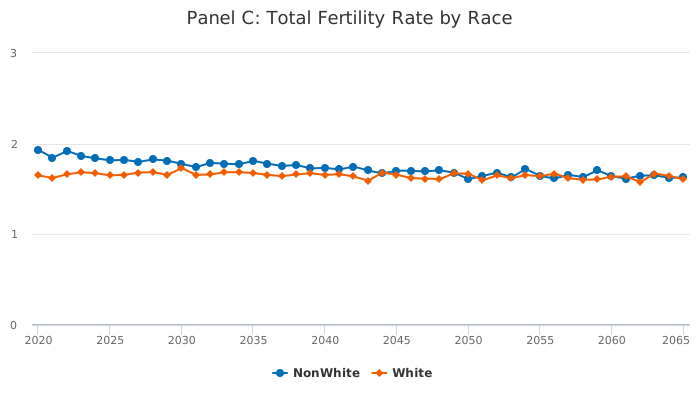
In Figure 1, Panel A shows that the TFR in the next few decades is projected to average about 1.7 per woman, well below the replacement rate of 2.1 children per woman. The projected trend in TFR declines, however, from above 1.7 in the near term and approaches 1.6 by the 2060s. Figure 1’s Panel B decomposes the TFR by female lifetime educational attainment: By those who attain college degrees and those who do not over their lifespans. Women who attain college degrees are projected to sustain lower fertility rates compared to those who do not. And Panel C shows that the white-nonwhite fertility differential is likely to abate over time. This occurs because of fertility postponement by non-white women as more of them pursue higher educational attainment.
Figure 2 shows that fertility rates by female age are projected to decline gradually and shift rightward over time. This projection carries forward the observed historical trend of fertility postponement associated with higher female lifetime educational attainment.
U.S. mortality rates by age are projected to decline. The PWBM microsimulation accounts for the changes in mortality by race, education, marital status, and other features.
Figure 3 shows that the overwhelming share of all deaths occur among adults aged 65 and older. The total mortality rate (TMR) will increase as members of the large baby-boomer cohort die by mid-century, after which the TMR will stabilize at just above 1 percent of the population per year.
Figure 4’s Panel A shows that compared to whites, blacks have higher mortality rates. Mortality rates of “other” races (Hispanic, Asian, and Alaskan Native, Pacific Islanders, and others) are lowest (yellow lines in Panel B). All races are projected to enjoy reduced mortality rates during future decades (dashed lines in Panel A). Panel B shows that women currently have lower mortality rates than men with the differential expected to persist over time. This occurs because a larger fraction of women will attain college education and will likely reap the gains in reduced mortality associated with education. Finally, Figure 4’s Panel C shows that college-educated individuals have lower mortality rates. Mortality differentials across education groups are projected to narrow over time.
When fertility rates are below the population replacement level, immigration can make up the shortfall to keep population growth positive. This has been true since the decline of U.S. fertility rates to well below the population replacement level of 2.1 after the Great Recession of 2008-09.


Figure 5 shows net immigration rates by education and race and a decomposition of immigrants by legal status. Panel A of the Figure shows that immigrants will far outnumber emigrants. After the recent immigration surge passes, annual net immigration is projected to be about 0.3 percent of the population. Panel B shows that after accounting for additional education acquired after immigrating into the United States, the share of college and non-college immigrants are projected to be similar. Panel C shows that non-white immigrants will continue to outnumber white immigrants.
Figure 6 shows that immigrants’ population share is projected to increase in the future. The share of unauthorized nonresidents is projected to decline from 3.4 percent today to 2.7 percent by the 2060s.
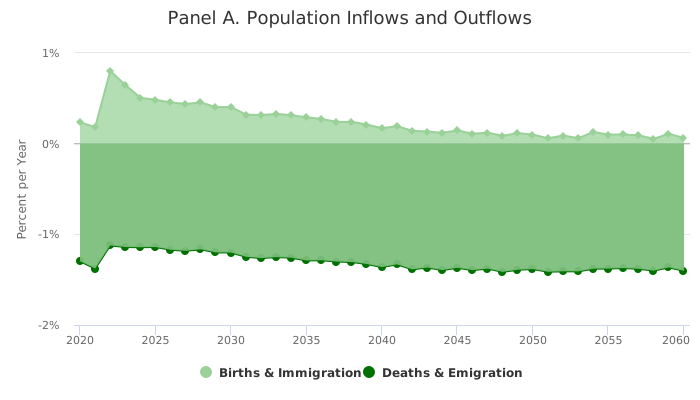

Population growth depends on the relative strengths of factors that add people (births and immigration) relative to those that remove people (deaths and emigration) from the resident population. Figure 7 shows projected outcomes of births, deaths, immigration, and emigration as shares of the total population. Panel A of the Figure shows that births-plus-immigration will dominate deaths-plus-emigration through the next few decades but the strength of the former relative to the latter will weaken. Panel B shows an alternative view: Births net of deaths and net immigration. The four elements generate positive but declining population growth through midcentury.
Although U.S. birth rates have declined and are projected to remain below the population replacement rate of 2.1 per woman, net immigration and improvements in longevity will continue to generate positive population growth through 2100.
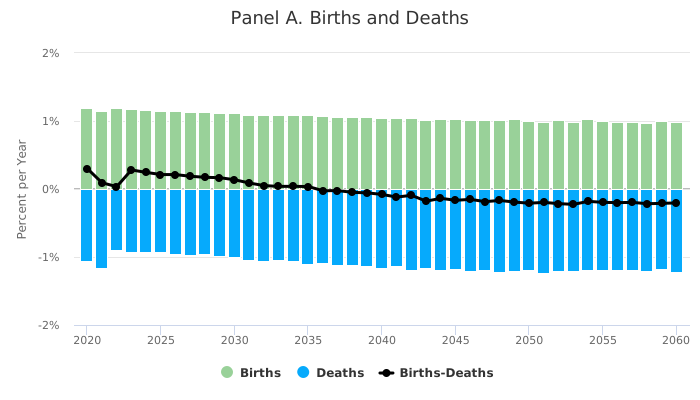
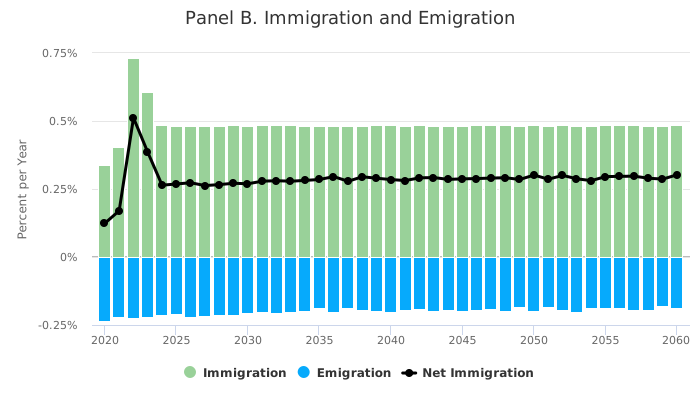
Figure 8’s Panel A shows details of births and deaths: Deaths spiked during 2020 and 2021 due Covid-19. They are projected to revert toward 1 percent per year during the next few decades. Births, however, are projected to decline gradually over time. Panel B of the Figure shows high rates of immigration during the first few years after 2020, reflecting the on-going “border crisis.” The immigration rate is projected to remain more than twice as large as the emigration rate, which helps to maintain a positive, albeit declining U.S. population growth rate (shown in Panel B).
The future U.S. population will be shaped by changes in its age distribution, racial mix, and lifetime educational attainment. Figure 9 shows the distributions. Panel A of the Figure shows that the U.S. adult population today is characterized by the baby-boomers entering retirement followed by their successors (the “echo boomers”) in their twenties and thirties. And Panel B shows that by 2065, both male and female lifetime educational attainment groups will be larger compared to today (lighter shaded areas show shares of those with a college degree; darker shaded areas show those without a college degree).
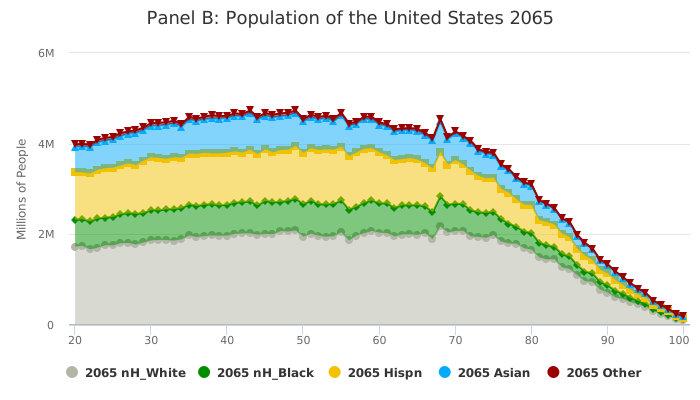
In the legend, “nH” stands for “non-Hispanic.”
Panel A of Figure 10 shows that younger (non-adult generations) are smaller than the “echo-boomers,” consistent with recent declines in U.S. fertility rates. It shows the distribution of today’s U.S. population by five race categories (white non-Hispanic, non-white non-Hispanic, Hispanic, Asian, and Other). Finally, Panel B of the Figure shows the 2065 U.S. population decomposed by race. It shows that the racial composition of the population will shift markedly toward a smaller share of non-Hispanic whites and larger shares of other race groups, especially Hispanic and Asian.

Panel A of Figure 11 shows that the population share of persons aged 65 and older is projected to increase over time. That increase is projected to cause a rapid initial decline in the worker-retiree ratio from 2.9 today to about 2.3 by 2035, as Panel B shows. The ratio is projected to continue declining after the 2030s and approach 2.0 by the 2060s as the population continues to grow older.
Panel A of Figure 12 shows the PWBM microsimulation’s projections of annual increases among workers (aged 25-64, blue line) and retirees (aged 65 and older, red line). Both microsimulation time series include immigration into each group as projected under current immigration policy, most of which augments the working age group.
Nevertheless, the ongoing shift of baby boomers from the worker to the retiree group implies that annual increases among retirees far outstrip those of workers. Indeed, worker transitions into the older group are so large that the increase in workers (blue line) is smaller than net immigration of workers (yellow line).
The large increase in retirees relative to workers is projected to reduce the worker-to-retiree ratio (black line in Panel B of Figure 12) from almost 3.0 today to 2.0 by 2075. One potential way of preventing the decline in the worker-retiree ratio is to increase annual immigration levels. Increases in net immigration each year would cumulatively increase the number of workers. This means that increasing legal immigration (by some multiple of the current level) would shift the time profile of the worker-retiree ratio upward.
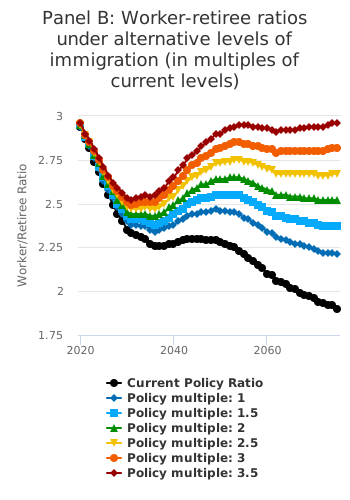
How large would the increase in legal immigration have to be to restore the worker-retiree ratio, over the long term, back to its current level? The lines in Panel B of Figure 12, which show the worker-retiree ratio under alternative multiples of current immigration levels (beginning in the year 2020) provide the answer: A multiple of 3.5 (uppermost dark red line) would be required.
This analysis was produced by Jagadeesh Gokhale. Prepared for the website by Mariko Paulson
-
See Congressional Budget Office, “The Demographic Outlook, 2024-2054,” January, 2024. ↩