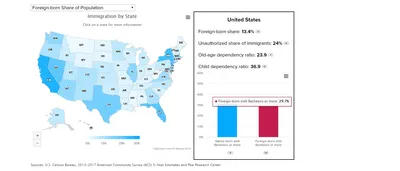
PWBM projects the number of unauthorized immigrants to fall from a peak of 4 percent of the U.S. population in 2007 to under 2.5 percent in 2050. In recent years, fewer unauthorized immigrants have arrived from Mexico while more have arrived from Central America. PWBM projects that future growth of the population of unauthorized immigrants will be driven by visa overstays.
By substantially expanding the standard deduction, the Tax Cuts and Jobs Act reduced the incentive to make charitable contributions. We make use of data on non-tax itemizers to examine several potential policies designed to increase tax incentives for charitable giving. In particular, we project that a non-refundable credit for charitable contributions for filers who don’t itemize would expand giving by $208 billion (5.2 percent) and reduce tax revenue by $267 billion (0.6 percent) over the 10 year budget window. Other reforms produce smaller increases in giving along with smaller losses in revenue.
When making projections of key macroeconomic aggregates such as total output, earnings and payroll tax bases, the Social Security Trustees assume that future labor-productivity growth will continue to remain close to its historical average. The labor productivity projection derived from this assumption is applied to the projected worker population on a per-head basis to project the aforementioned variables. However, assuming labor productivity growth near its historical average implicitly assumes that all contributing factors will also grow close to their historical rates or changes in those factors total will be mutually offsetting. However, the future composition of workers by productive abilities will differ from the past, potentially causing inconsistency between projections of key macroeconomic aggregates and the underlying characteristics of the future population. One solution is to project as many of the productivity-contributing elements as possible using micro data information and organize them under an aggregate production function framework. This approach forces the budget analyst to define all productive inputs consistently with underlying demographic projections. Under such an approach, labor productivity growth is an auxiliary output consistent with micro-data-based projections of future worker populations, their attributes, macroeconomic aggregates, and projections of finances for programs such as Social Security. PWBM's microsimulation-based projection of U.S. demographic and economic features yields labor productivity growth estimates that are significantly smaller during the next few decades compared with the close-to-historical average rate of labor productivity growth assumed by the Social Security Trustees. Subtracting PWBM's average projected labor-productivity growth over the next 75 years (2018-92) from the Social Security Trustees' assumed value of 1.68 percent per year yields a difference of 26 basis points. If the effects of changes in the population's demographic attributes on labor productivity growth are excluded from PWBM's projection, the difference from the Trustees labor-productivity growth assumption equals 32 basis points.