Effective Tariff Rates and Revenues (Updated September 10, 2025)
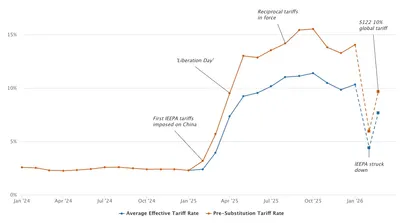
The USITC recently released updated trade and tariff data . We use this data to provide up-to-date estimates of customs revenue and effective tariff rates through July 2025.
PWBM estimates that the COVID-era Employee Retention Credit (ERC) will have cost more than $300 billion when the IRS finishes processing claims later in 2025, nearly four times the initial projected cost. Most of the ERC was paid retroactively, well after pandemic-related economic disruptions had ended, limiting its effectiveness as a worker retention incentive.
We estimate that AI will increase productivity and GDP by 1.5% by 2035, nearly 3% by 2055, and 3.7% by 2075. AI’s boost to annual productivity growth is strongest in the early 2030s but eventually fades, with a permanent effect of less than 0.04 percentage points due to sectoral shifts.
The USITC recently released updated trade and tariff data . We use this data to provide up-to-date estimates of customs revenue and effective tariff rates through June 2025.
It is well known that mass deportation reduces aggregate economic variables like GDP due to scale effects. We project that deportation also reduces wages of high-skill workers, compromising 63% of workers. Still, authorized low-skilled workers can see their wages increase but only if the deportation policy is permanently sustained after 4 years. Even with new funds provided in the 2025 OBBBA, we estimate that permanent deportation would cost an additional $900 billion over the first 10 years.
We estimate that importers avoided 13.1 percent ($6.5 billion) of new tariffs by accelerating purchases and changing their purchasing patterns in response to the new tariff regime. Importers especially stockpiled pharmaceuticals and precious metals during 2025 Q1.
We estimate the reconciliation bill signed by President Trump increases primary deficits by $3.2 trillion over 10 years. The dynamic cost, including changes to the economy, is larger at $3.6 trillion. GDP falls by 0.3 percent in 10 years and 4.6 percent in 30 years.
For the final bill, please see our analysis of the President Trump-Signed Reconciliation Bill .
Deporting unauthorized workers over 10 years cuts Social Security revenue, raises deficits by $133 billion (10 yrs) and $884 billion (30 yrs). The Trust Fund depletes 6 months earlier; 75-year deficit rises by 0.25% of payroll.
For the final bill, please see our analysis of the President Trump-Signed Reconciliation Bill .